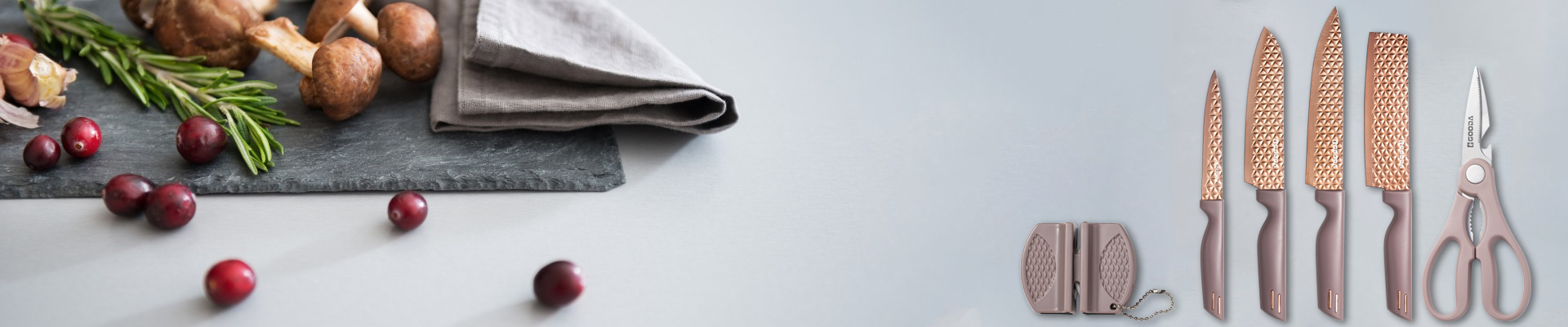
Avoid Wasting Money: A Comprehensive Guide: What a Worthwhile Set Looks Like
People always ask: Should I buy individual kitchen knives or a set? Are sets a waste of money?
Honestly: Choosing the right set is more cost-effective, practical, and aesthetically pleasing than buying individual knives; choosing the wrong one just results in a collection of dust and a waste of money.
Today, we'll specifically discuss knife sets—how to choose, how to avoid pitfalls, who should buy them, and how long a set will last.
I. First, understand: Are you suitable for a knife set?
Three situations where a set is suitable; if you meet one of these, go for it:
1. New home renovation, newly rented apartment, or completely replacing kitchen utensils—buying everything at once is the most convenient.
2. Don't want to do research and want to get knives, scissors, and a knife rack all at once.
3. Prefer neat organization and a unified kitchen aesthetic.
If you already have a good main knife and only need a fruit knife or cleaver, then buy individual knives, not a set.
II. What should a good kitchen knife set include? A high-quality knife set isn't about "more is better," but about having every piece usable and no useless parts.
An ideal household knife set includes:
• Chinese chef's knife: Primarily for cutting vegetables and meat
• Chopping knife: For ribs, chicken, and duck
• Santoku knife/Multi-purpose knife: For fine processing, slicing, and cutting fruit
• Fruit knife/Peeler: Separates cooked food and fruit for better hygiene
• Kitchen scissors: Versatile for cutting chicken bones, scallions, and packaging
• Knife holder/Magnetic rack: Clean storage, well-ventilated to prevent mold
III. Knife Set Avoidance Guide: Avoid these 3 types:
1. Oversized sets with a dozen or so pieces: Cheap but all plasticky. Thin blades, lightweight, and easily dulled. Seems like a bargain, but you'll want to throw it away after a few uses.
2. All-wood handles + enclosed knife holders: Damp and poorly ventilated, prone to mold, bacteria, and handle cracking, posing a significant hygiene risk.
3. Focusing only on appearance, ignoring the steel: A beautiful but soft, easily dulled, and chipped blade is unsuitable for Chinese cooking, no matter how pretty it looks.
IV. When buying a knife set, consider these 3 points to avoid mistakes:
1. Steel: High-carbon stainless steel is the most reliable choice for home use.
No need to chase Damascus steel; 3Cr or 4Cr steel is sufficient for daily use—sharp, rust-resistant, easy to maintain, and offers the best value.
2. Feel: Stable center of gravity, comfortable grip.
The most common mistake with knife sets is choosing ones that are "light, flimsy, and lack a good grip." Choose sets that have weight but don't feel heavy in your hand.
3. Storage: Ventilated knife block / Magnetic knife holder.
Prioritize knife blocks with openwork design for drainage, or opt for magnetic holders—clean and sophisticated.
V. Knife Set Usage and Maintenance Tips
• Use a dedicated knife for its intended purpose; never use the main knife to chop bones.
• Wash and dry immediately after use; do not soak in water for extended periods.
• Use bamboo or PE cutting boards; avoid glass or marble.
• Sharpen regularly; a set of knives can easily last 5-8 years.
A concise, practical, and high-quality knife set can make your kitchen tidier, cooking smoother, and life more enjoyable.
Instead of buying a bunch of cheap individual knives that will clash with each other, it's better to invest in a high-quality, functional, aesthetically pleasing, and durable set.