
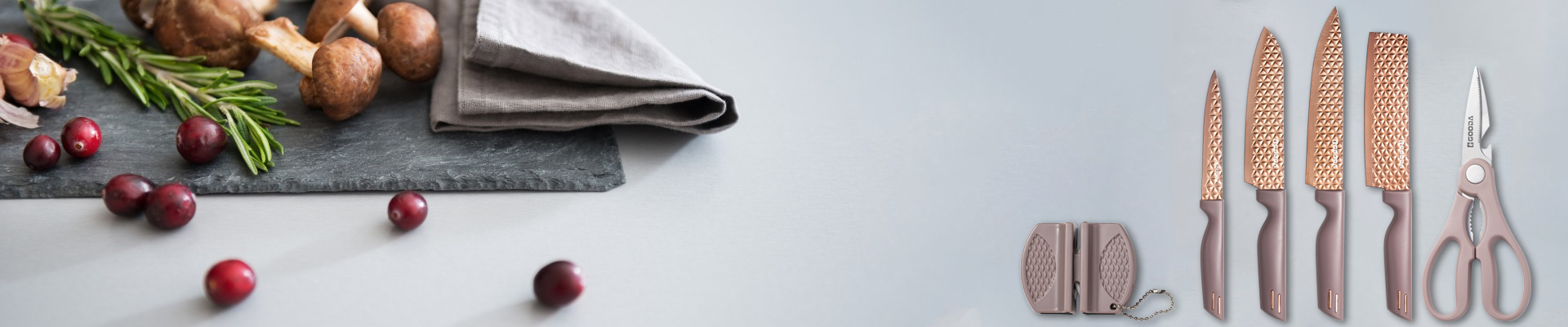
Why Are More Kitchenware Brands Launching Their Own Private Label Knife Collections in 2026?
The kitchen knife industry is undergoing a significant transformation. Just a few years ago, many retailers and e-commerce sellers relied heavily on well-known knife brands to drive sales. Today, an increasing number of businesses are choosing a different path: launching their own private label kitchen knife collections.
From Amazon sellers and online retailers to supermarket chains and specialty kitchenware stores, private labeling has become one of the fastest-growing trends in the kitchen products market.
But what is driving this shift, and why are so many brands investing in custom OEM knife collections?
Consumers Are Buying Brands, Not Just Knives
Modern consumers have access to thousands of kitchen knife options online. As a result, product specifications alone are no longer enough to stand out.
Many successful sellers have realized that customers are more likely to remember a brand story, packaging experience, and product identity than the steel grade of a blade.
This is why private labeling has become so attractive. Instead of competing solely on price, businesses can build a recognizable brand that customers trust and return to.
A customized logo, unique packaging design, and carefully selected color scheme can transform a standard knife set into a premium product experience.
The Rise of Lifestyle-Oriented Kitchen Products
Kitchen tools are no longer viewed as purely functional items.
Today's consumers often choose products that match their home décor, lifestyle, and personal preferences.
Neutral colors, Scandinavian-inspired designs, matte finishes, natural wood handles, and minimalist packaging are becoming increasingly popular.
As a result, retailers are looking for OEM manufacturing partners that can offer more than standard products. They need flexibility in design, materials, and branding to create collections that reflect current market trends.
Private Label Products Offer Better Profit Margins
One of the biggest challenges in online retail is price competition.
When dozens of sellers offer identical products, profit margins quickly shrink.
Private label knife collections help solve this problem by creating differentiation. Since the product is unique to the brand, direct price comparisons become more difficult.
This allows businesses to maintain healthier margins while increasing customer loyalty.
For many Amazon and e-commerce sellers, this strategy has become essential for long-term growth.
Packaging Has Become a Powerful Marketing Tool
In many cases, customers experience the packaging before they experience the product itself.
A well-designed gift box can significantly increase perceived value and create a memorable unboxing experience.
Many successful knife brands now invest heavily in:
- Custom gift boxes
- Color printing
- Instruction booklets
- Brand story cards
- QR codes linking to product videos
These small details help transform a kitchen knife set into a premium consumer product.
OEM manufacturers that provide packaging customization are becoming valuable partners in brand development.
Small and Medium Businesses Can Now Compete with Larger Brands
Years ago, launching a private label knife brand required large investments and massive production volumes.
Today, manufacturing technology and supply chain efficiency have made customization more accessible than ever.
Businesses can start with selected product lines, test different market segments, and gradually expand their collections based on customer feedback.
This flexibility allows smaller companies to compete effectively against established brands without carrying excessive inventory risk.
What Retailers Should Look for in an OEM Knife Manufacturer
Not all manufacturers are equally equipped to support private label projects.
When selecting an OEM partner, retailers should consider:
- Product quality consistency
- Material options
- Logo customization methods
- Packaging development capabilities
- Quality control procedures
- Production lead times
- International shipping experience
A strong manufacturing partner should be able to support both product development and brand growth.
Final Thoughts
The future of the kitchen knife market is no longer dominated solely by large international brands.
Private label collections are creating new opportunities for retailers, distributors, and e-commerce sellers to establish their own market identity.
As consumer demand continues to evolve, businesses that invest in branding, product differentiation, and customized solutions will be better positioned for long-term success.
For companies looking to build a unique kitchen knife collection, partnering with an experienced OEM manufacturer can be the first step toward creating a brand that customers remember.
Brief introduction
Gooda is a top kitchen knife wholesale distributor and manufacturer. Our factory is located in the city of Yangjiang, Guangdong Province, China. We have been committed to providing top-quality kitchen knife sets while maintaining the highest standards of integrity and customer service. We provide detailed information about our products in order to give customers the utmost confidence in the product they are purchasing.
Certificate
R&D capability
In the increasingly competitive kitchen knife market, some unique and innovative kitchen knife products can help to further improve your business. For kitchen knife companies, their R&D capabilities are crucial to deliver superior and sustainable kitchen knives, which can differentiate them and their business partners from their competitors in the market. In addition, kitchen knife manufacturers with strong R&D teams are able to provide you with some custom kitchen knife solutions to meet the needs of your specific kitchen knife project.
Test Certificate
The quality of kitchen knives must be the top priority, because it not only affects the life and maintenance costs of kitchen knives, but also affects people's safety and health. Our team strictly controls the quality, and samples are taken from time to time for testing to ensure that our products can pass LFGB and FDA standards